
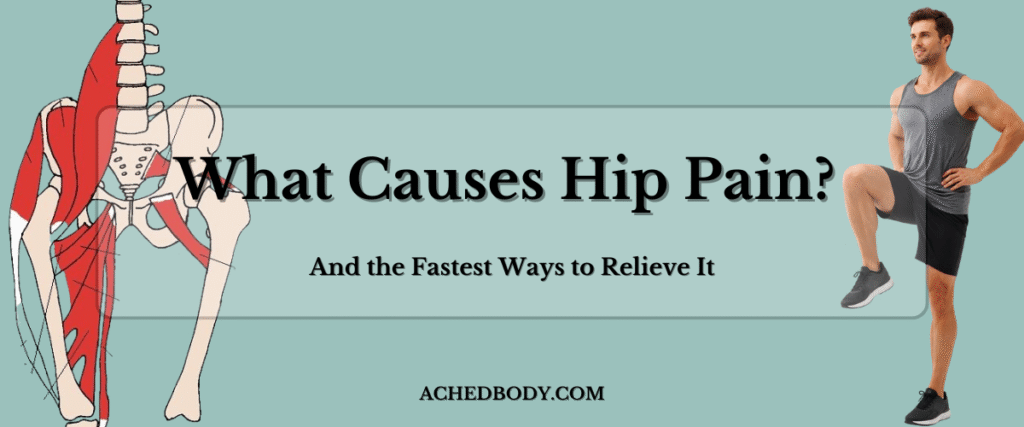
The crazy thing about hip pain is – Most hip pain has nothing to do with the hip joint itself. It comes from the muscles around it—especially your hip flexors.
Below, you’ll learn exactly why hip pain happens, how to tell where your pain is coming from, and how to use specific stretches, trigger point therapy techniques, and mobility to get relief.
Where You Feel Hip Pain (And What Each Location Means)
This all starts with understanding location. Different pain spots usually point to different problems.
But let’s get one thing straight.
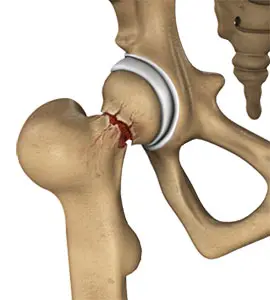
There are cases where there can be structural damage to the bone, fibrocartilage or connective tissue that trigger point therapy and stretching will not remedy directly.
Obviously, reducing tension around joints is a way to prevent further damage, but if structural damage has been done, seeing a doctor is important.
The hip is a complex joint with a lot of muscles involved. Here are some common pain areas and the muscles most likely responsible.
Front of the hip (most common)
Pain here could mean a lot of things. You may have a tight psoas or iliacus trigger points, rectus femoris strain or simply hip flexor overuse from sitting, or activity.
Deep groin pain
The muscles that are responsible for this are typically the Iliacus and Psoas again. But you could also have general hip capsule compression or hip impingement (painful “pinch” with squatting or lifting knee).
Outer hip pain
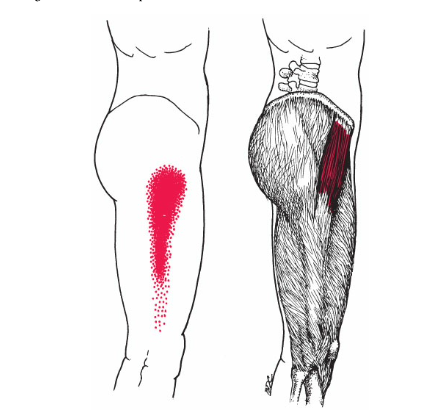
The outside of the hip is usually TFL tightness, Glute medius weakness or a combination of the two.
This can lead to overcompensation during activity.
Hip + lower back pain together
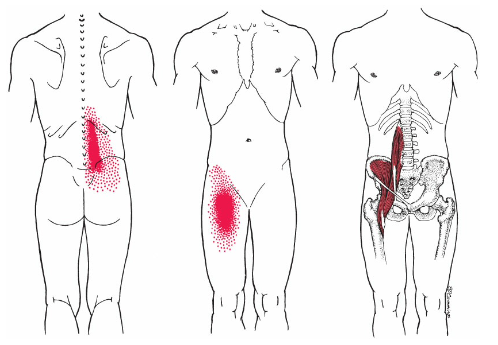
A tight psoas pulling the spine into extension and potentially a tight QL muscle in yor low back are to blame.
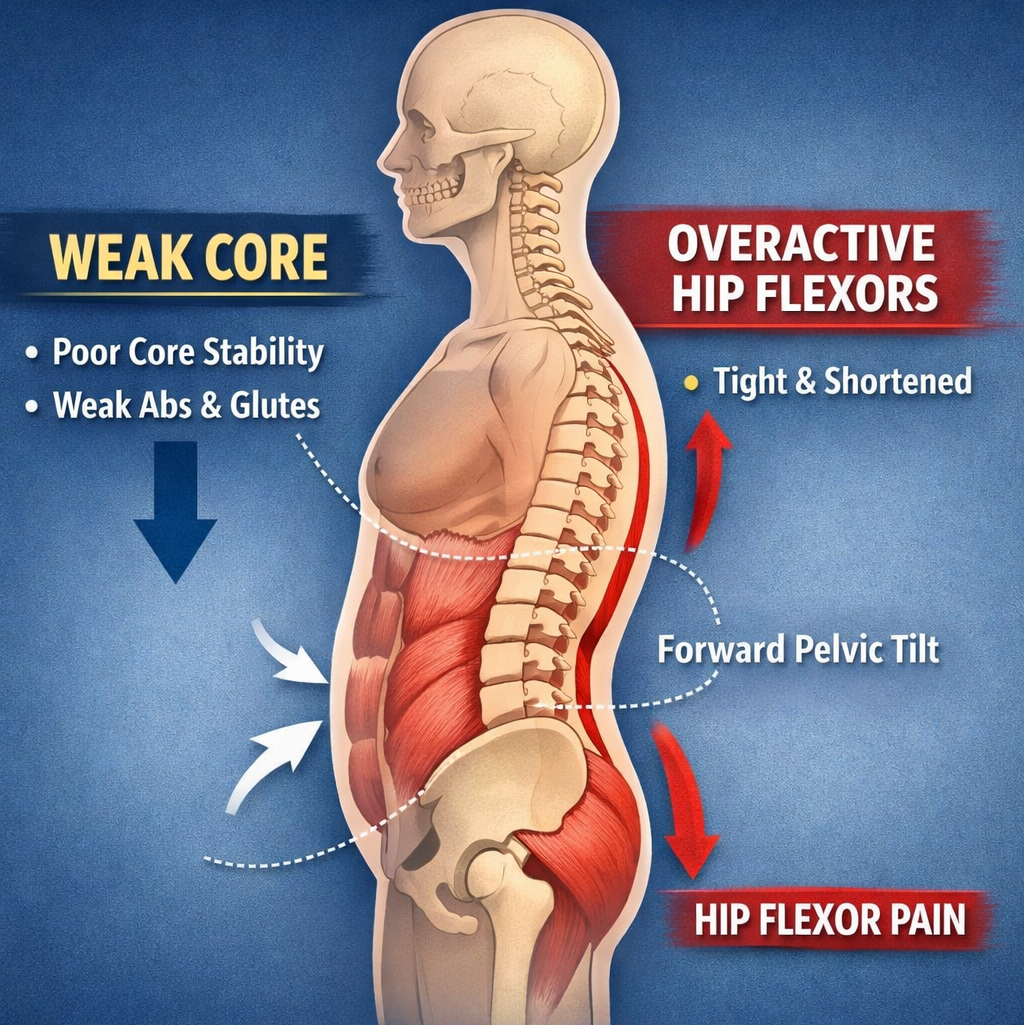
This along with weak glutes can lead to unwanted pelvic tilt forcing the low back to work too hard and cause low-back compression.
Hip pain that travels to the knee
Sometimes hip pain and knee pain are intertwined. That’s because joints that are near eachother will have similar muscle use or pick up the slack when one is not working properly.
Muscles like the rectus femoris and Iliopsoas can alter knee mechanics.
Too complicated? Here’s a cheat sheet:
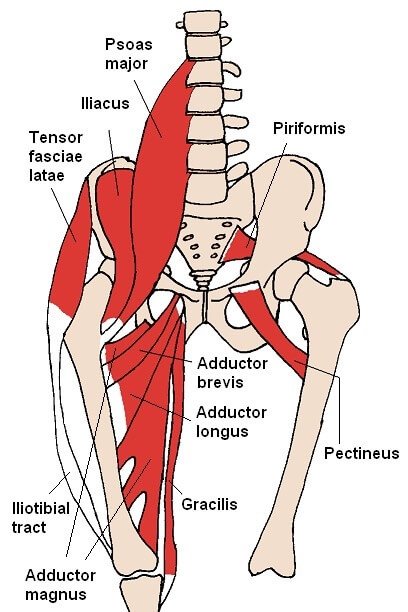
It isn’t always going to be 100% accurate but:
If the pain feels deep inside the front of your hip, it’s usually psoas.
If it feels like a thin band from hip to knee, it’s often rectus femoris.
If it feels like outer hip ache or IT band pain, it’s probably TFL.
Tight Hip Flexors: The #1 Cause of Front-Side Hip Pain
Hip flexors become tight from two main things: sitting and exercise. Both create the same problem in different ways.
Your hip flexors adapt to a shortened position either from long term seated work or getting overworked.
That’s when they start sending pain signals.
Key symptoms of tight hip flexors include:
– Front-hip stiffness when you stand up
– Pain lifting your knee
– Low-back tightness
– Feeling “locked up” when walking
– Trouble straightening your leg behind you
This tightness often gets mislabeled as “my hips are out of alignment,” but it’s really a muscle imbalance between the hip flexors and the glutes.
Even more importantly, different hip flexor muscles produce different pain patterns.
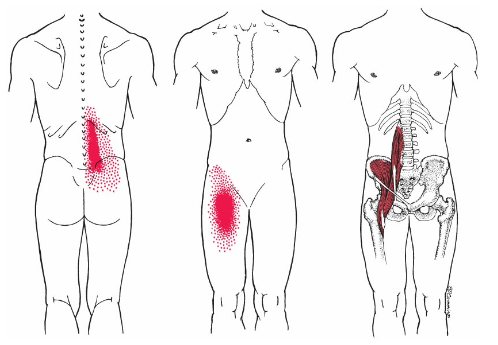
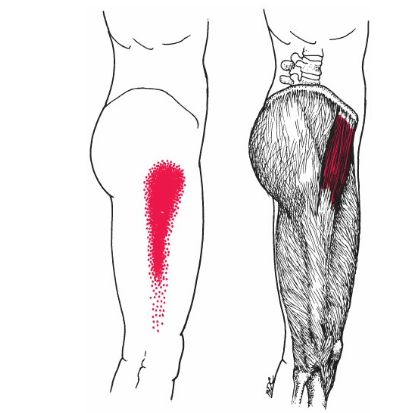
Hip Flexor Pain vs Hip Joint Pain: How to Tell the Difference
This is where people often get confused.
Hip flexor pain feels like:
– A tight band at the front of the hip
– Pain lifting your knee
– Pain lunging or stretching
– Pain after sitting
– Relief from gentle stretching or trigger point work
Hip joint pain feels like:
– Often a A deep “pinch” in the groin
– Often a sharp pain
– Pain all the time, not just in motion
– No relief from stretching
Pro Tip: If stretching makes your hip pain worse, there’s a good chance the issue is inside the joint or the hip flexors are too inflamed to stretch yet.
Hidden Muscle Causes of Hip Pain (Most People Never Learn This)
Hip pain often comes from supporting muscles that get overloaded without you realizing it.
1. TFL (Tensor Fasciae Latae)
From: Myofascial Pain and Discomfort third edition
– Produces outer-hip pain
– Overworks when glutes are weak
– A major culprit in “tight hip flexors”
Learn how to trigger point it here.
2. Rectus Femoris
– Crosses both hip and knee
– Causes hip + knee pain combo
– Gets tight from exercise most often, but can still happen in sedentary lifestyle
Check out my quad trigger point guide or the best quad stretches here.
3. Psoas
– Deepest hip flexor
– Tightens from stress + sitting
– Pulls the spine forward → low-back pain
This can be fixed with a massage therapist, active release technique specialist or with the use of a theracane. Learn how in my hip-flexor trigger point article.
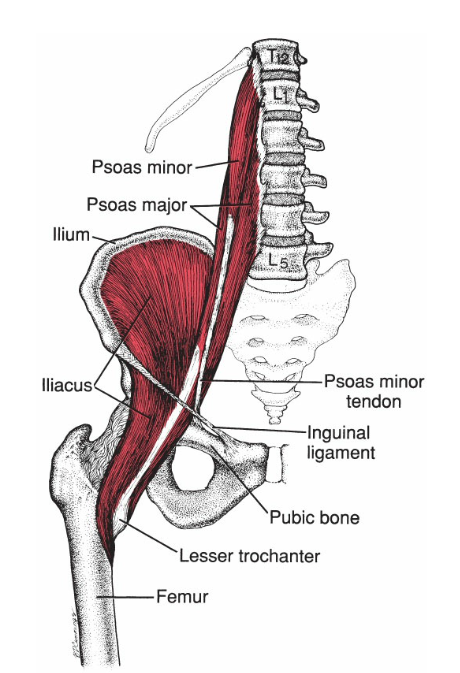
4. Iliacus
– Sits inside the pelvis
– Causes groin pain
– Feels like a deep “pocket of tension”
5. Glutes (yes, glutes can cause hip pain too)
I go over the different glute muscles and deep hip rotators in my glute articles which you can find here.
Why Hip Pain Spreads to the Lower Back and Knee
The hips sit at the center of your body’s movement system. When hip flexors get tight, everything above and below starts compensating.
Tight hip flexors → pelvis tilts forward → low back compresses → back pain.
Tight hip flexors → rectus femoris overload → knee pain.
Tight hip flexors → glutes shut off → hips lose stability → walking feels harder.
Once the hip flexors start pulling everything out of alignment, the pain rarely stays in one place.
What Causes Hip Pain? (The 7 Most Common Reasons)
Here are the biggest contributors to hip pain, in simple terms:
1. Sitting too long

This shortens hip flexors, weakens glutes, and compresses the low back.
Consider standing up periodically to stretch if you sit for long periods of time.
2. Weak glutes
The weaker your glutes, the more it forces your hip flexors to work. This is because the glute muscles are supposed to help with hip stabilization.
If they aren’t there to help the hip flexors have to hold everything together.
3. Overactive hip flexors
Common in runners and lifters.
4. Running with tight muscles
Increases tension in psoas, iliacus, and rectus femoris.
5. Poor lifting mechanics
Especially squats, deadlifts, lunges.
6. Core imbalance
Weak deep-core muscles force hip flexors to stabilize the spine.
7. Trigger points
Small knots in hip flexors referring pain to the back, groin, or knee. Learn more about specific patterns in the hip flexors here.
How to Relieve Hip Pain Fast (3-Step Method)
This is the fastest and most reliable method for loosening tight hip flexors and reducing hip pain quickly.
Step 1: Trigger Point Release
Click here for the detailed breakdown.
Start by finding and releasing the tightest spots in:
– Psoas
– Iliacus
– TFL
– Rectus femoris
This immediately reduces tension so stretching works effectively.
Each muscle requires a slightly different technique to target the trigger points well so be sure to watch the video below to see how I do it. (coming soon)
After you trigger point, it’s the best time to stretch. This is because the muscle spindles in the muscle are relaxed which means your nervous system will allow you to lengthen without as much resistance.
Step 2: Stretch the Hip Flexors
I have created a list of hip flexor stretches from most accessible to the more advanced stretches.
Be sure to check the list and make sure that you choose a stretch that will target the correct muscle for your situation.
From there, a 30-60 second hold with deep breaths will start the process, but I recommend doing a few rounds and going slightly further each time if you want lasting relief.
The hip flexor stretching article is a great place to begin and here’s a video of some of the stretches you can try.
Step 3: Light Mobility + Glute Activation
It’s one thing to have passive range of motion (stretching), but it’s a whole other level to have full control of your hip mobility.
This is a struggle of mine, but this is what bullet proofs you for training hard and everyday life.
Read a detailed breakdown here (coming soon)
Great options:
- Hip rotation drills
- End range testing
- 90-90 drills
- deep squat drills
- Cat-cow
- Low-back decompression
- Glute bridges
Over time, this 3-step flow delivers relief because it addresses the root issue and reintegrates the muscles to a healthy balance.
When Hip Pain Means You Shouldn’t Stretch
Sometimes stretching makes hip pain worse. Avoid stretching if you ever feel sharp pain or shooting pain.
If this happens, see a health professional to get hands on treatment from a local expert.
How Long Hip Pain Takes to Go Away
Most people notice relief anywhere from a single session to 2–3 weeks for chronic tightness or long-term issues.
You’re improving if:
– Pain moves from sharp → dull
– You feel less pulling during walking
– The hip starts to “open up” more easily
If pain doesn’t change at all, that’s usually a sign the issue is deeper in the hip joint or the hip flexors are extremely inflamed.
What’s Next?
If you want the guides on trigger pointing your hip flexors, stretching your hip flexors or are curious about learning more actionable advice, you can get all of that in my fix your hip-flexors category page.
As always let me know if you need anything!
Good Luck!
-Nick