
Tight hip flexors will give you aches and pains all over. You feel it at the front of your hip, down your thigh, into your groin, or even in your lower back.
And they tighten easily, but the good news is they also respond quickly to the right kind of trigger point therapy and stretching techniques.
This guide shows you exactly how to stretch your hip flexors with the 5 best hip flexor stretches I have found for attacking the issue from all angles.
The Hip Flexors Explained (Simple Anatomy)
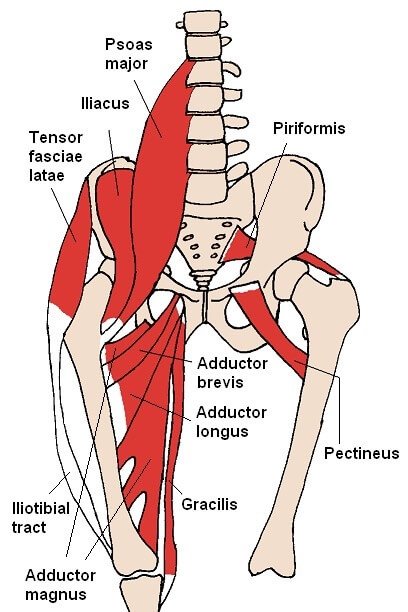
You don’t need a full anatomy lesson—just enough to understand what you’re stretching.
Psoas
– Deep muscle connecting spine to leg
– Produces deep front-hip or low-back pain
Iliacus
– Sits on the inside of the pelvis
– Causes groin or front-hip tightness
Rectus Femoris
– Quad muscle that crosses the hip
– Causes hip + knee pain combo
TFL (Tensor Fasciae Latae)
– Outer hip muscle
– Tight when glutes are weak
– Produces pain in the IT band or outer hip
Sartorius
– Long thin muscle from hip to knee
– Triggers diagonal-line pain
Different stretches hit different hip flexors, which is why the wrong stretch will never be enough.
And don’t forget, there are a ton of glute muscles that can impact hip health AND the hamstrings play a role in hip movement.
So if the hip flexor therapies like foam rolling or trigger pointing don’t work, spend some time on those muscles too!
How to Stretch Your Hip Flexors the Right Way
This is the most important part of stretching your hip flexors:
You won’t feel the stretch unless you get into a posterior pelvic tilt (PPT).
Most people lunge forward and stretch everything except the hip flexors.
Ego stretching is not the goal. It’s not about how low you can get.
It’s about getting the stretch to the intended target.
How to create a posterior pelvic tilt:
– Squeeze your glutes
– Tuck your tailbone slightly
– Lift your ribs gently
– Keep the core tight
Once you set the tilt, you barely need to lean forward to feel the stretch.
What to avoid:
Avoid arching the lower back and forcing your hips forward more than you should.
It is also important that you don’t collapse at the ribs or hold your breath.
If your hip flexors are extremely tight, the proper form will immediately make the stretch feel more intense (in a good way).
The 5 Best Hip Flexor Stretches (Beginner to Advanced)
Below are the most effective stretches for tight hip flexors. Each one includes what it targets, how to perform it, and coaching cues to make it work.
1. Half-Kneeling Hip Flexor Stretch
Targets: Psoas, iliacus
How to Do It:
– Kneel on one knee
– Step the other foot forward
– Create a posterior pelvic tilt
– Shift forward slightly while keeping the tilt
Make sure you:
– Squeeze your glutes
– Keep your ribs down
– Don’t arch your back
Best For: Everyday tightness, posture reset, after sitting
Pro Tip: Rotate your back leg to target the TFL a bit more!
2. Leg Hangers (Edge of Bed or Couch)
Targets: Psoas, rectus femoris
How to Do It:
– Lie on your back near the edge of a bed, couch or table
Use a pillow or some pad to support your low back/tailbone area
– Let both or one leg hang off the side
Allow gravity to lengthen you at the hip flexors.
– Optional: Pull opposite knee toward your chest
Make sure you:
– Let the hanging leg drop naturally
– Keep lower back neutral
– Don’t force the stretch
3. Couch Stretch
Targets: Rectus femoris, TFL, hip flexors
How to Do It:
– Place shin against a wall or couch
– Bring opposite foot forward
– Lift chest while squeezing glutes
Pro Tip: Use something stable to keep you upright.
Trigger point your quad before this stretch for the ultimate relief.
4. Deep Lunge/split with Hip Flexor focus
Targets: All hip flexors
How to Do It:
– Get into a deep lunge or split
Make sure you keep your hips square! No ego stretching.
– Lower back knee
– Lean forward slightly while lifting chest
Don’t forget to maintain your pelvic tilt.
The more you can keep your chest tall, the more the stretch will go to your hip flexors.
5. Reverses Pigeon
Targets: Psoas
Be careful to not torque your knee when doing this stretch. Support it with your arm like I do in the video. This stretch is about sinking the hip down, not leaning forward.
How to Do It:
– Get into a pushup position and bring one leg forward as if you’re doing a deep lunge
– Then walk your foot to the outside (internally rotating the hip)
– Sink your hip down while supporting your front leg in the crease of your elbow.
You should feel the stretch in your back leg hip flexor. If you want a deeper stretch, slowly walk your back leg backwards to deepen the stretch.
How Long to Hold Hip Flexor Stretches
If your goal is to exercise or perform directly after stretching it is best to not hold deep positions for long.
That’s because the muscles take time to adjust back and forth and you can have lower dynamic performance following a deep stretch session.
If you are trying to dramatically improve your flexibility or mobility in an area, you have to spend a lot of time in the position.
As long as you are not feeling over the top pain, you can stretch for as long as you want.
I tend to hold stretches for 30-60 seconds per rep and work in activation of the stretched muscle for added muscle resilience.
That’s called PNF stretching. Learn more about it here.
Should You Stretch Hip Flexors Every Day?
Most people can stretch hip flexors daily as long as the stretches are not too intense.
If you have chronically tight hips, then stretching every day is probably necessary to get out of that hole.
What’s Next?
If you want the guides on trigger pointing your hip flexors, stretching other muscles around your hip flexors or are curious about learning more actionable advice, you can get all of that in my fix your hip flexors category page or my Ultimate Stretching Guide.
As always let me know if you need anything!
Good Luck!
-Nick