
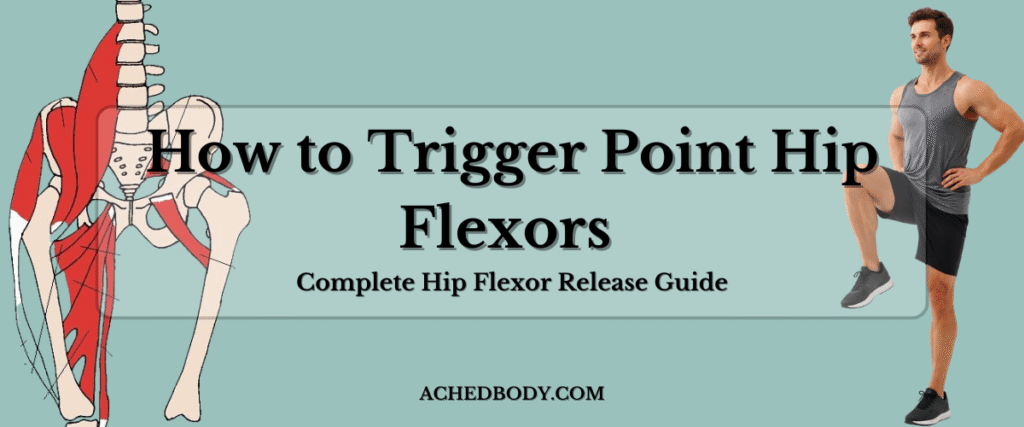
When your hip flexors get too tight, they can develop trigger points.
Stretching your hip-flexors alone won’t fix the problem either.
Trigger points keep the muscles locked, stiff, and sensitive—creating deep front-hip pain, low-back tightness, groin discomfort, or even knee pain.
The fastest way to loosen them is through targeted trigger point release.
Skip ahead to learn how to release your hip flexors – Click here!
What Hip Flexor Trigger Points Feel Like
Hip flexor trigger points create a very specific type of discomfort. If any of the sensations below feel familiar, keep reading to fix it for good.
Any aching around the hip, upper quad or around the IT band are great signs that your hip flexors need some help. The hip flexors can also be responsible for low back pain.
If you injured your hip and have sharp pains with normal movement, please see a professional in your area, as you may have some structural damage.
Trigger points also create referred pain, which means you feel the discomfort in places the muscle isn’t even located. The hip flexors are notorious for this.
Why Hip Flexor Trigger Points Form
Hip flexors tighten and develop trigger points for predictable reasons:
Sitting – Keeps the muscles shortened and compressed for hours.
Running/Cycling – Overloads the psoas and rectus femoris with repetitive force.
Strength Training – Squats, lunges, step-ups, and deadlifts can strengthen but cause issues when mobility is limited.
Weak Glutes – Forces the hip flexors to stabilize the pelvis.
Stress and Breathing Patterns – The psoas responds to stress and shallow breathing by tightening.
When some or all of these factors combine, the hip flexors shorten, lose mobility, and develop trigger points that turn against you.
Anatomy of Hip Flexor Trigger Points (Explained Simply)
Psoas
– Deep muscle connecting spine to leg
– Trigger points cause low-back tightness and deep front-hip pain
– Hard to access but extremely important
Iliacus
– Sits inside your pelvis
– Creates groin pain and front-hip discomfort
Rectus Femoris
– Quad muscle that crosses both hip + knee
– Trigger points cause hip and knee pain together
TFL (Tensor Fasciae Latae)
– Outer hip muscle
– Tight when glutes are weak
– Often misdiagnosed as hip flexor pain
Sartorius
– Long diagonal muscle from hip to knee
– Creates a “stripe-like” pain pattern
Each of these requires a slightly different release technique.
How to Release Hip Flexors Safely (Start Here)
For a better understanding of the different muscles look at my “what causes hip pain” article.
Here are the muscles we will target with trigger point therapy:
- Psoas
- Iliacus
- Rectus Femoris
- TFL (Tensor Fasciae Latae)
- Sartorius
Trigger point release should feel intense but safe—never sharp, stabbing, or electric. Before you begin:
And here are the rules of trigger pointing:
- Always start with light pressure, increase over time
- Breathe slowly to relax the muscle
- Stay under your pain threshold 6-7 out of 10 on the pain scale
And when you’re done with a trigger point release, stretch that muscle to get the most out of it!
Now let’s release those muscle knots.
Trigger Point Release for the Psoas and Iliacus
The psoas is deep, so you’re likely not going to press directly on it—you’ll be releasing the fascial layers above it.
How to Release It:
Hopefully you have a thera-cane or something like this to pressure into your muscles.
But here’s the deal, there are some organs in that area that we want to avoid
so please watch this video below to see how I access these muscles properly.
Video coming soon!
- Lie face up with your leg in a bent position (see video)
- Place the straight end of the thera cane into the inner crest of your pelvis (Iliacus)
- slowly slide the edge of the cane up and halfway towards your spine (Psoas)
- Slowly increase pressure while taking deep breaths, resetting after each breath or every 2 breaths.
Now to super charge the release, you can add in some active release technique!
To do that, after you pin the muscle, slowly let your leg extend out to the straight position.
Then, reset and do it again until you feel like you get relief!
How to Release It with a Massage Ball:
- Start laying on a large massage ball just inside your pelvis
- Apply light pressure and deep breaths
- Let your body melt over the ball
- Hold for 3-5 breaths or 30-60 seconds
Safety Notes:
– You should NOT feel sharp pain
– Stop if you feel nausea or nerve zaps
– Less is more—don’t overdo psoas or Iliacus release
Trigger Point Release for the Rectus Femoris
This is your front-thigh muscle that often mimics hip flexor pain.
How to Find It:
– Sit or lie face down
– Place a ball or foam roller on the front of your thigh
– Roll slightly until you find a sharper, tender spot
How to Release It:
There are a few techniques to try
You can pressure point by holding pressure on a sensitive trigger point.
You can roll across the muscle to loosen it as well. Watch the video to get a visual of what it looks like.
And finally, you can use active release techniques. Once you find a spot, apply pressure, then straighten your knee and hip joints slowly.
This will force the muscle to lengthen while being pressured, giving it a stretch and release at the same time.
Trigger Point Release for the TFL
The TFL is located at the outer front-hip and often causes the sensation of IT band pain.
How to Find and Release It:
This muscle is small, so getting this part right is a necessity.
Take a lacrosse ball and place it under the front of your hip while you lay on it.
Bend your lower leg like I show in the picture and keep the ball pressuring into the muscle.
(bending your leg will put the muscle in a relaxed position, so it’s easier to locate.)
Then, use a cross rolling technique or pressure point technique to target the trigger points.
Hold a pressure point for 30 seconds or so and then immediately stretch the area.
Watch this video to see it (coming soon)!
Don’t forget to breathe into it and target the area with a stretch after you finish trigger pointing.
Trigger Point Release for the Sartorius
This muscle creates diagonal-line pain from hip → inner knee.
It looks like this…
How to Find It:
It is usually best to get this treated by a massage therapist because its difficult to target on your own with a massage ball.
But that doesn’t mean it’s impossible.
We will just roll it in 2 stages.
Lay face down and take a foam roller or large massage ball up by your hip
Pressure just below the origin point (anterior superior iliac spine)
Then roll diagonally down and across towards the knee only moving 6 inches or so to target the upper portion of the muscle
Target the lower section of the muscle by starting just above the medial knee joint area.
Then roll up your leg while turning slightly so the roller moves onto your medial quad muscle.
As always stop on any sensitive areas and breathe into the pressure for 30-60 seconds.
What to Do After Trigger Point Release
Your hip flexors need guidance after release or they’ll tighten back up.
Check out my hip flexor stretch page to get the step by step guide (and videos) on how to do it.
If your hip isn’t getting better from hip flexor therapies, you may need to address your glutes, hamstrings or even your quad muscles!
When Trigger Point Release Makes Things Worse
Stop immediately if you ever feel a sharp joint pain or any shooting pain.
Also, if you are sore the next day, that means your intensity was too high. Try backing off and using less pressure or a softer tool next time.
If your pain worsens with these techniques, please see a local doctor or physical therapist.
What’s Next?
Learn more about the hip flexors here. And if you’re interested in figuring out how to target other trigger points in your body check out this ultimate guide to trigger pointing I made. It has step by step guides with pictures and videos.
Good Luck!
-Nick