
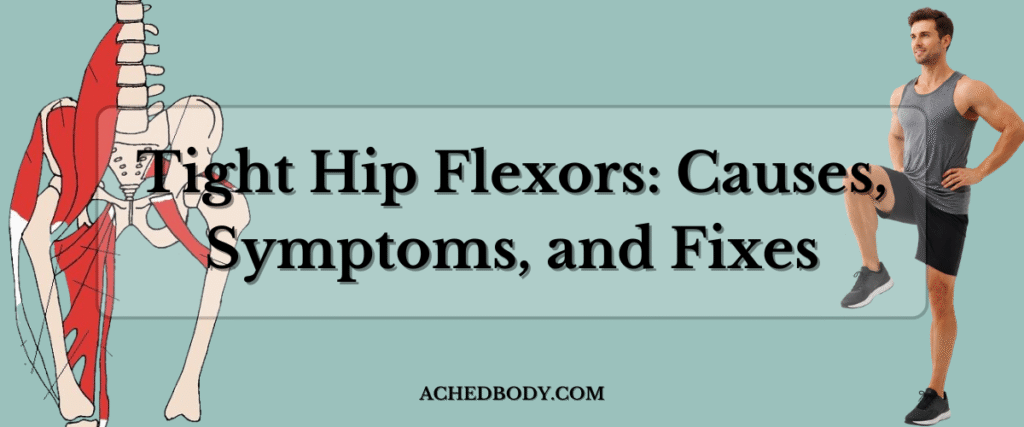
Tight hip flexors create a very specific kind of discomfort: front-hip tension, difficulty standing tall, pulling in the low back, stiffness after sitting, or a “pinching” feeling when you walk or run.
These muscles tighten easily—and stay tight easily…
This guide breaks down why your hip flexors get tight, the symptoms you should look for, and what I do to fix them.
Skip to:
- Why Tight Hip Flexors Are So Common
- What Tight Hip Flexors Actually Mean
- Symptoms of Tight Hip Flexors
- Signs You Have Tight Hip Flexor
- Simple At-Home Assessment
- 7 Reasons Your Hip Flexors Are Tight
- How To Fix Tight Hip Flexors
Why Tight Hip Flexors Are So Common
When you sit, they shorten. When you run or lift, they work hard to stabilize your spine and assist in the movements.
When your glutes are weak, they cling on for dear life.
And when you’re stressed, the deep hip flexor (the psoas) tightens in response.
Over time, these muscles stop relaxing fully, leading to mobility loss, stiffness, and pain.
If you haven’t yet read the breakdown of how hip pain forms, see What Causes Hip Pain?—it covers the hidden reasons your hip flexors tighten in the first place.
What Tight Hip Flexors Actually Mean (Not What Most People Think)
“Tight” doesn’t always mean the muscle is physically short. Often, it means:
– The hip flexors are overworked
– The glutes aren’t helping
– The body is using tightness as stability
– There are trigger points causing inefficiency in your movement
This is why stretching alone rarely solves the problem. Trigger points and muscle imbalances must be addressed first—a process explained deeply in How to Trigger Point Hip Flexors.
Symptoms of Tight Hip Flexors
These symptoms usually show up together:
– Pulling at the front of the hip
– Decreased hip extension (can’t straighten leg behind you)
– Pain or tightness after sitting
– Lower-back stiffness
– Hip “pinching” during lunges or squats
– Groin discomfort
– Difficulty standing tall
– Lower abdominal tightness
If these match your experience, your tightness is likely coming from hip flexor overload—not the hip joint.
For more help identifying your pain pattern, the pain-location breakdown in What Causes Hip Pain? fits perfectly with this section.
Signs You Have Tight Hip Flexors (And Not Another Problem)
You’re dealing with tight hip flexors if:
– Stretching the front of your hip gives temporary relief
– The tension returns after sitting
– You feel pain lifting your knee
– You struggle to fully extend your hip
– You feel better when walking slowly, worse when walking fast
– Your hip feels “stuck” or “blocked” when running
For those deeper issues, see How to Trigger Point Hip Flexors—it shows how to release psoas, iliacus, rectus femoris, and TFL.
Tight Hip Flexors Test (Simple At-Home Assessment)
This is the modified Thomas Test, made simple.
How to do it:
First, set up a camera so you can record yourself
- Sit at the edge of your bed or a counter
- Lie back while pulling one knee to your chest
- Let the other leg hang naturally
How to read your results:
If the hanging leg stays lifted: your psoas is tight.
If the knee can’t bend to 90°: your rectus femoris is tight.
If your leg drifts outward: your TFL is tight.
If your pelvis tilts or your low back arches: the whole group is involved.
Use my How to Stretch Hip Flexors to target whichever muscle tested tight.
Why Are My Hip Flexors So Tight? (The 7 Main Reasons)
1. Sitting too long
Keeps hip flexors in a shortened position for hours. Getting up periodically to stretch throughout the day will drastically change the way your hips feel.
2. Weak glutes
Your hip flexors compensate for missing strength in your glutes. Building strength in your glutes with exercises like this may help your hip flexors to let go of their tightness.
3. Running and sprinting
Psoas and rectus femoris absorb repetitive load. Over time this can become chronic tightness.
4. Quad dominance in lifting
The goal is not only to build strength in the body, but to have the correct balance of strength across the different muscle groups.
If you become over reliant on your quads for hip extension movements, your hips will adapt by tightening.
This will further exacerbate your issues so be sure to use full range of motion when exercising and consider doing some hip flexor isolated movements.
5. Stress
The psoas tightens with shallow breathing and tension.
6. Weak deep-core muscles
If you have a weak core, your hip flexors will step in and stabilize your spine when the core is underactive.
7. Trigger points
AND last but not least, muscle knots freeze hip flexors into a shortened state and can contribute to all of the issues we talked about above.
How to Loosen Tight Hip Flexors (Step-by-Step Fixes)
The three-step method I use is below. It’s the most proven way to fix any muscle, so here’s the overview:
Step 1: Release Trigger Points
Focus areas:
– Psoas
– Iliacus
– TFL
– Rectus femoris
This reduces guarding so the hip flexors can lengthen.
Guided instructions are found in How to Trigger Point Hip Flexors.
Step 2: Stretch Properly (Not the Way Most People Do
Most people stretch incorrectly, arching their back instead of lengthening the hip flexors.
Use a posterior pelvic tilt to get a real stretch.
Detailed instructions are listed in How to Stretch Hip Flexors.
Step 3: Add Light Hip Mobility
Use guides like this on youtube for some good hip mobility.
Ideally you can do these to reintegrate the hip flexors and learn to use them properly in your movement patters
What’s Next?
Sometimes chronic tightness can be a sign of a deeper issue:
You could have a pelvic tilt, weak glutes and many other issues like chronic stress.
If intense body work like stretching and trigger point therapy don’t completely solve the issue, you may want to try other muscles in the area.
Related areas are the glutes, quads and hamstrings!
If you have any questions please reach out and as always good luck!
-Nick