
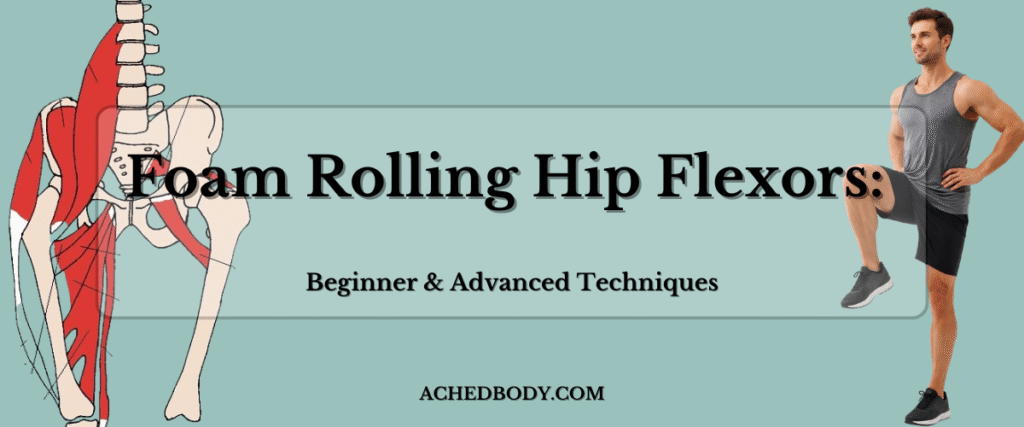
Foam rolling your hip flexors can reduce stiffness, improve mobility, and release tension in the front of the hip and upper thigh.
But it has to be done correctly—rolling too aggressively or in the wrong spots can instantly make hip pain worse.
This guide walks you through:
- How to find the correct muscle for you
- Which techniques actually work
- When to switch from foam rolling to deeper trigger point release.
Should You Foam Roll Your Hip Flexors? (The Real Answer)
Foam rolling is helpful for some of the hip flexors like the Rectus femoris and TFL muscle.
Those muscles are much more accessible to a foam roller which differs from the deeper Illiacus and Psoas muscles.
Those require slower, more targeted work—covered in depth in How to Trigger Point Hip Flexors.
Anatomy You Need to Know Before Foam Rolling
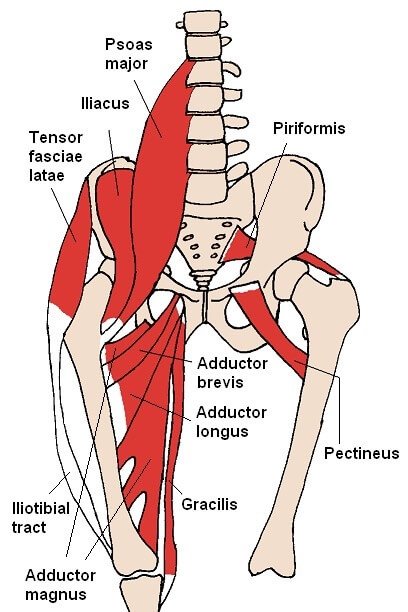
Knowing what you’re rolling makes all the difference and most people are surprised to know which muscles pull your leg up at the hip joint!
Rectus femoris
The best target for foam rolling. It can also respond really well to trigger point techniques.
TFL
This muscle is a little known muscle, but it is usually responsible for IT band and outer hip pain.
It can be rolled safely but requires a little bit of technique. Skip ahead to read about it!
Psoas & Iliacus
These two are Too deep to roll with a foam roller. Read my trigger point article to see how I use a thera cane to release the deeper tension.
After the foam rolling and trigger pointing is all done, be sure to stretch the areas with these targeted hip flexor stretches.
Foam Rolling Techniques for Hip Flexors
Think of foam rolling as a wide brush stroke—great for general tension. Trigger point release is precise and targets deeper knots.
These foam rolling methods should give all the benefits without irritating the hip.
Front-Thigh Roll
If you think your problem is your rectus femoris try this.
–Start lying face down and place the roller under your mid-upper thigh.
– Roll slowly up and down 4–6 inches or across the central thigh muscle
As you explore you will likely find some tension.
When you do, rest on it for 30-60 seconds.
Pro Tip – Add in some knee flexion on your trigger point by pulling your heel towards your butt.
You should feel pressure but no sharp pain at all.
This targets the rectus femoris, which often mimics hip flexor tightness.
When done, stretch your quad with one of these stretches to get the full relief.
TFL Foam Roll
This can be done with a foam roller or a massage ball like in the trigger point guide for the hip flexors.
– Lie slightly on your side, roller angled slightly above and in front of your hip
The TFL is the muscle that sits right where the pockets of your pants would be.
– Bend your bottom leg and pull your knee up to about a 45 degree angle
– Roll small 1–2 inch sections
– Move slowly
Using a massage ball or lacrosse ball will have better results. Watch this video to get the full understanding.
Foam Rolling Mistakes That Make Hip Flexors Worse
Avoid these common errors:
Rolling directly on the hip bone
It’s not the end of the world, but rolling is for soft tissue, not bone.
Rolling too quickly
Muscles are slow when it comes to releasing tension. That’s why fast rolling usually does nothing or makes the muscle tighten up even more.
Forcing your body weight
If you use too much pressure, too soon, the muscle will protect itself by holding on tighter. Unfortunately that is the last thing we want to happen.
Rolling without stretching afterward
This is not the end of the world either, but to get the most out of your session, stretch after you trigger point the muscle. That’s because the pressure will temporarily inhibit the muscle, making it easier to relax into a stretch. Which gets you better, faster!
The best follow-up stretches are here in my article How to Stretch Hip Flexors.
How Long Should You Foam Roll Hip Flexors?
This is a simple answer.
Nearly everybody can safely trigger point or foam roll one area for 30-60 seconds at a time.
As long as you keep the pain at a maximum of 6-7 out of 10, you should see therapeutic results.
Afterall, you should feel relief—not soreness—when you’re done.
When Foam Rolling Isn’t Enough
Foam rolling won’t fix deeper issues like:
– Psoas or iliacus trigger points
– Hip joint impingement
– Chronic glute weakness
– Deep hip compression
– Pelvic tilt problems
If foam rolling gives no relief or worsens the pain, switch to the targeted release program in How to Trigger Point Hip Flexors and review the deeper causes explained in What Causes Hip Pain?
WARNING: IF YOU HAVE A STRUCTURAL ISSUE IN THE HIP JOINT OR BONE ISSUE, FOAM ROLLING, TRIGGER-POINT THERAPY AND STRETCHING WILL LIKELY NOT HELP. PLEASE SEE A LOCAL PROFESSIONAL.
What’s Next
I hope this was helpful. My goal is to help 1 million people get rid of their pain.
If you need specific help feel free to reach out to me or look at my ultimate guides for the most detailed help for every body part!
Good Luck!
-Nick