
When was the last time you saw anybody stretch their core?
Probably close to never.
And since you are here, you probably want to learn how.
Well you’re in luck because this article walks through:
- Why ab stretching matters
- The only abdominal stretches you need
- How you can super-charge your core stretching
Why Tight Abs Are More Common Than You Think
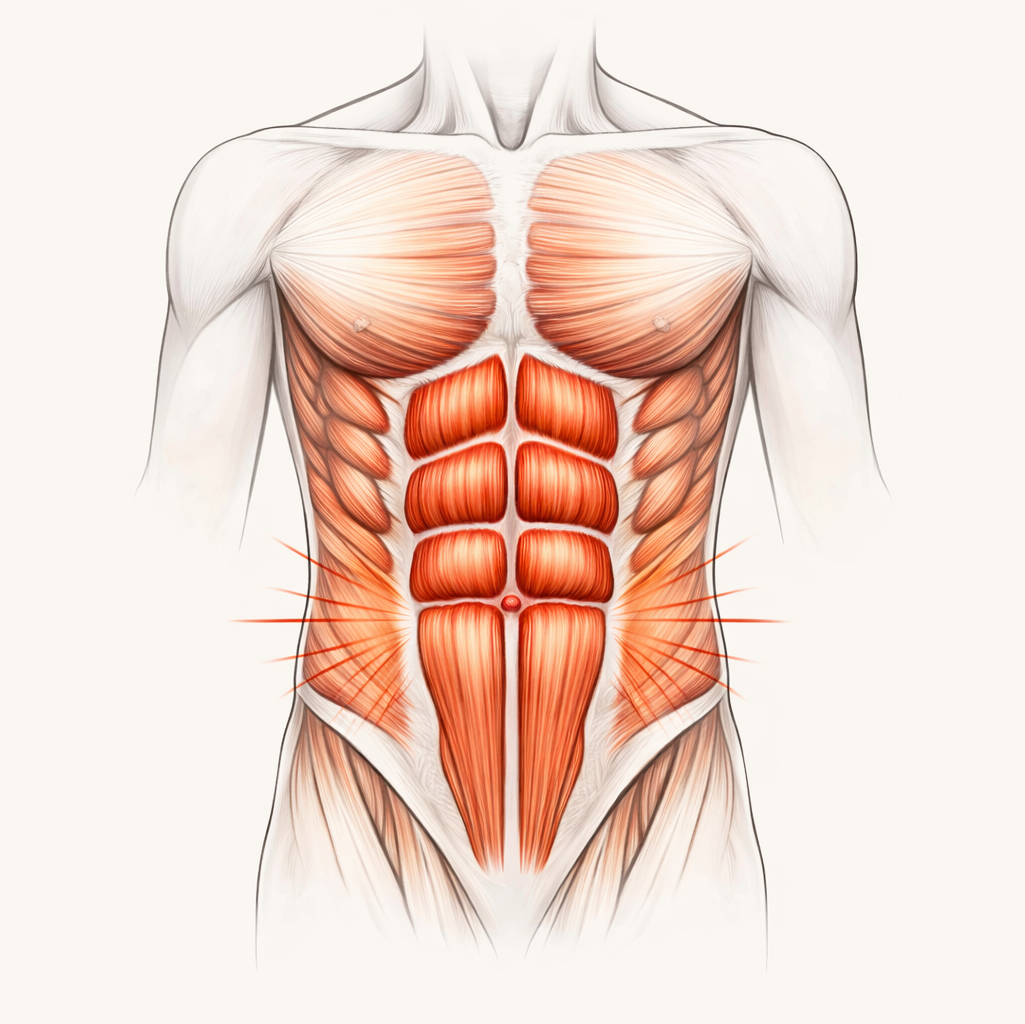
Your ab muscles have probably taken a beating over your whole life.
That’s because they’re constantly involved in daily life. They stabilize the spine, assist with breathing, and help transfer force between the upper and lower body.
Over time, chronic tightness will cause the body to compensate and change how your body moves and breathes.
This is where trigger points and general tightness will develop.
But here’s how to fix it!
The Top Stretches For Your Abdominals
The key to success is to breathe deeply. It makes a difference.
Upward Dog
- Lie face-down with legs straight and the tops of your feet on the floor.
- Place your hands under your shoulders, elbows close to your sides.
- Press through your palms and lift your chest forward and up.
- Straighten your arms and lift your thighs off the ground.
- Pull your shoulders down and back, lightly squeeze your glutes.
- Hold for 15–30 seconds, breathing slowly, then lower with control.
Tip: If this feels too intense on your lower back, keep your thighs on the floor and perform a gentler Cobra pose instead.
Rotating Upward Dog (Oblique & Transverse Abdominis Stretch)
- Start in Upward Dog: hands under shoulders, arms straight, thighs lifted, chest open.
- Keep your hips square and lightly squeeze your glutes.
- Rotate your chest to the right, turning your rib cage while shifting weight towards one hand.
- Hold 10–15 seconds, breathing into the side of your waist.
- Return to center, then rotate to the left and repeat as needed.
Backbend (Wheel Pose)
- Lie on your back with knees bent, feet flat, hip-width apart, heels close to your butt.
- Place your hands by your ears with fingers pointing toward your shoulders.
- Brace lightly: tighten glutes and abs just enough to support your low back.
- Press up by pushing through your feet and hands to lift your hips and chest.
- Straighten your arms as able and let your chest open; keep knees tracking forward (not splaying out).
- Hold 5–15 seconds while breathing steadily.
- Lower with control: tuck chin slightly, bend elbows, and roll your spine down.
Note: If this is a difficult position to achieve, use an exercise ball to reach a similar position with less pressure.
Side Hang (Oblique Stretch)
- Grab a sturdy bar about belly button height with both hands.
- Kneel down and extend your legs backwards away from the bar.
- Twist your hips and turn your body to one side, extending the side of your core.
- Breathe into the stretch and use your top leg to help balance or relieve pressure if necessary.
- Switch sides and repeat.
Focus cue: Feel it in your side waist (obliques). You might also feel your lats—keep your attention on the obliques to emphasize the stretch.
Standing Side Bend
- Stand tall with feet hip-width apart and core lightly engaged.
- Reach your right arm straight overhead, palm facing in while placing your left hand on your hip for support.
- Lengthen up first, then gently bend to the left, keeping your chest facing forward.
- Keep both feet grounded and avoid collapsing into the low back.
- Breathe into the right side waist and QL for 20–30 seconds.
- Switch sides and repeat.
Cue: Think “reach up, then over.” The more upward length you create, the better the stretch will be.
Rotational Core (Often Forgotten)
Although these are typically used for the back muscles they can easily be adapted for your core.
Supine Spinal Twist
- On back, knees to chest, rotate side to side
- Great for obliques + lumbar decompression
Seated Twist
- Sit tall, rotate through ribs (not shoulders)
- Helps restore rotational core mobility
Honorable Mentions
Here are some extra light core stretches that you may like adding to your routine as well!
Child’s Pose Side Stretch
- Sit back into child’s pose
- Walk hands to one side
- Very joint-friendly QL and oblique stretch
Half-Kneeling Side Bend
- One knee down, same-side arm up
- Reach up and over for a controlled side-core stretch
Why Ab Stretching Sometimes Isn’t Enough
While abdominal stretching is essential, it does not always fully resolve abdominal tightness on its own. If the muscle tissue contains trigger points, stretching may feel temporarily relieving but tightness can return quickly.
Trigger points are small, sensitive areas within a muscle that restrict normal movement and circulation. In these cases, gentle trigger point release before stretching often leads to much longer-lasting relief.
If you suspect deeper tension is involved, learning how to safely release trigger points in the abdominal muscles can significantly improve how effective ab stretching feels.
Ideally, I like to trigger points before stretching to help open up the muscles faster. Learn more about trigger pointing your core here!
Do You Want More?
If you’re reading this then you’re definitely interested in fixing your body as much as possible.
For a deeper understanding of flexibility principles across the entire body, the Ultimate Stretch Guide is my go to resource.
Good luck!
-Nick